
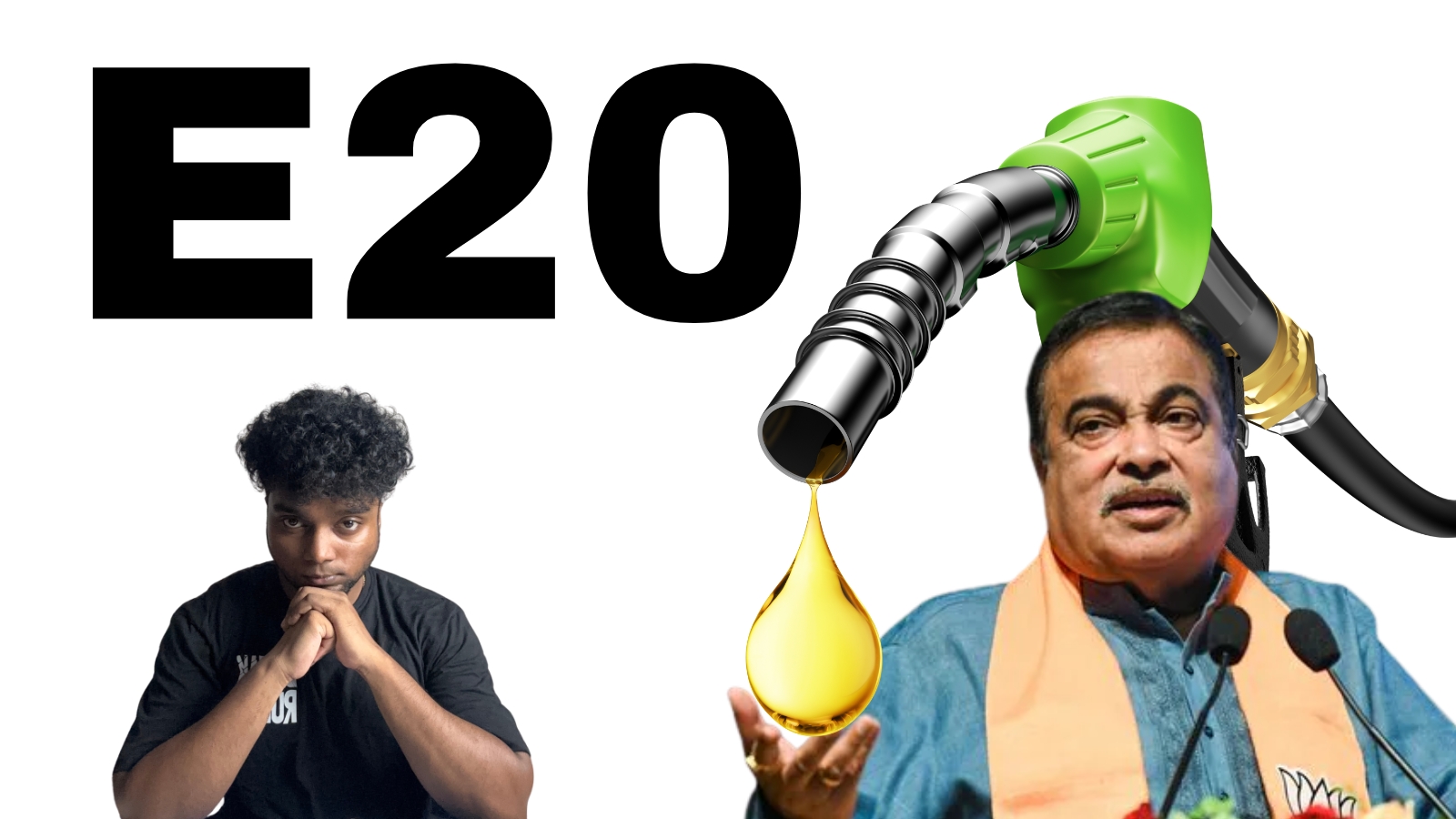
E20 Petrol: Why Your Mileage Dropped and Nobody Asked You
From April 2026, almost every drop of petrol in India is E20. Your mileage fell, the price did not, and nobody asked you. Here is the full story, both sides, and the sources.
You filled your tank this week and paid what you always pay. Maybe a little more. But something feels off. The needle drops a bit faster than it used to. The bike that gave you 45 on a good week now feels like 42. You are not imagining it, and it is not just your engine getting old. The petrol itself changed, and almost nobody told you.
The fuel in your tank is now E20. This is the full story of what that means, why your mileage fell, why it is not any cheaper, and why so many people across India are quietly calling it a scam. I will give you both sides and every source, so you can decide for yourself.
What actually changed
E20 means the petrol you buy is 20% ethanol and 80% actual petrol. Ethanol is basically alcohol, made mostly from sugarcane, molasses, and surplus grains like maize and rice.
From 1 April 2026, this is not optional. Almost every petrol pump in the country now sells E20 as standard, and plain petrol has quietly vanished from most stations. India hit this 20% blending target in 2025 to 26, a full five years ahead of the original 2030 plan.
So the fuel changed for everyone, at the same time, with no switch to flip and no other option at the pump. That single fact is the root of most of the anger.
Why your mileage dropped
Here is the simple science. Ethanol carries about 30% less energy per litre than petrol. Less energy in the tank means your engine squeezes fewer kilometres out of the same litre.
That 30% number got twisted online into "E20 cuts your mileage by 30%," and the government correctly pushed back on that. A 30% mileage crash is not happening. The real figures the government itself admits are smaller: roughly 1% to 2% for newer cars built for E20, and up to 6% for older ones. For a car doing 20 km per litre, that is around half a kilometre less per litre.
But this is where owners disagree with the official line. In one large survey, about 66% of people driving petrol vehicles made before 2023 said their mileage fell by more than 10% since early 2025. The government says its lab numbers are right. Many drivers say their fuel bills tell a different story. The truth for you probably sits somewhere in between, and it depends heavily on how old your vehicle is.
The part that actually stings: it is not cheaper
You might think, fine, ethanol is homegrown and cheaper than imported crude, so at least the fuel should cost less. It does not. E20 costs you the same as petrol did, and is sometimes more expensive to produce.
The government explained why. It buys ethanol from Indian producers at a fixed rate to keep farmers earning, around ₹71 per litre for maize based ethanol before other costs are added. At today's crude oil price of about $70 a barrel, making E20 is actually costlier than making plain petrol, not cheaper. The Petroleum Ministry has openly said the goal of E20 was never a cheaper pump price. It was energy security.
Now put the two facts together and see it from a normal person's side. You pay the same money. You get slightly fewer kilometres. So your real cost per kilometre went up, quietly, without a single rupee changing on the price board. Nobody announced that.
So is E20 a scam?
A lot of people online are using that exact word. Let me lay out the case fairly, because the honest answer is more interesting than a simple yes or no.
Here is why people feel cheated:
No choice. Pure petrol was pulled from most pumps. You cannot opt out, even if your vehicle was never designed for E20.
No price cut. You absorb the mileage loss but see no saving at the pump.
Older vehicles carry the risk. Cars made before April 2023, and even some newer ones, were not certified for E20. Owners worry about long term engine wear, rubber and metal parts, and grey areas in warranty and insurance if something fails.
The benefits flow elsewhere. The big wins are for the country and the farm economy, not the person filling the tank.
And here is the government's side, which is not weak:
India imports around 85% of its crude oil, a bill of over ₹11 lakh crore a year. Every litre of homegrown ethanol chips away at that dependence.
The programme has reportedly saved India close to ₹1.84 lakh crore in foreign exchange and put roughly ₹1.25 lakh crore into farmers' hands.
It has cut a large amount of CO2 emissions, helping India's climate targets.
A price fixed near ₹71 a litre does not swing every morning with wars and shipping costs, which adds stability to fuel prices.
When someone challenged the rollout in the Supreme Court, asking for an ethanol free option and clear labelling at pumps, the court rejected the plea and backed the government's plan.
So is it a scam? In the criminal sense, no, and throwing that word around loosely is neither fair nor accurate. But is it a raw deal for the individual driver, decided without your consent and without a price break? For older car owners especially, that argument is very hard to dismiss. The anger is less about theft and more about being given no say.
What about your older car?
This is the fear that keeps people up at night. If your vehicle was made before April 2023, it was likely certified only for E10, not E20.
The government's position, backed by testing from ARAI, SIAM, the oil companies, and carmakers, is that E20 is safe to run in E10 engines, and that no widespread pattern of engine failure has appeared since the rollout. Maruti Suzuki pointed to service data covering millions of older, non E20 cars and reported no E20 linked damage.
The practical takeaway is calm, not panic. Track your real mileage. Keep up with servicing. If you own a much older or high value vehicle, ask your manufacturer directly about E20 and your warranty, in writing, and keep the reply.
Then there is E85 and E100
E20 is only the beginning. You will start hearing two more names.
E85 is petrol with up to 85% ethanol. E100 is pure ethanol fuel, which India gave full legal recognition to in June 2026. Neither is for your regular car. They run only in flex fuel vehicles, which have engines and software built to adjust to high ethanol levels automatically.
One warning worth repeating loudly: never put E85 or E100 into a normal petrol vehicle unless the maker certifies it as flex fuel. On these high blends the mileage drop is much bigger too, around 4 km per litre less on E85. The country is slowly moving toward these blends, which is exactly why the E20 fight matters now and not later.
Why not just go electric instead?
This is the fair question. If the goal is to cut oil imports and emissions, why push ethanol at all instead of EVs?
The honest answer is that both are happening, and each solves a different problem. Ethanol works with the crores of petrol vehicles and pumps that already exist, so it delivers savings today, without anyone buying a new car or waiting for charging stations. It also sends money straight to farmers.
EVs are the longer game. Analysts expect petrol demand to keep climbing until around 2032 and then fall as EVs take over, because they are cheaper to run. But EVs need charging networks, big upfront money, and a cleaner power grid to be truly green.
Ethanol has its own critics here, and they raise a sharp point. Growing crops for fuel uses a lot of land and water, and in a country that still worries about feeding everyone, some experts argue that the same land and sunlight would do more good generating power for EVs than growing sugarcane for fuel. Both sides have a real case. The likely future is a mix, not one winner.
Why is this hitting everyone right now?
Because the last escape hatch just closed. As long as you could still find normal petrol somewhere, E20 was easy to ignore. From April 2026, that choice is gone at most pumps. Millions of older vehicles are suddenly running a fuel they were not built for, drivers are watching their mileage at every single fill, and there is no cheaper option and no opt out. A change that was years in the making finally reached every tank at once, and that is why your feed is suddenly full of it.
The honest bottom line
E20 is not a secret crime. It is a real national strategy with real benefits: less oil imported, more money to farmers, lower emissions. Those are not small things, and pretending they do not exist would be as dishonest as any government spin.
But it was rolled out onto ordinary people with no choice, no price relief, and a quiet cost in mileage that lands hardest on older vehicles. You help fund the country's energy security every time you fill up, and nobody asked whether you agreed to the deal. That is the real story, and that is why people are angry. Not because ethanol is evil, but because the bill arrived without a conversation.
Track your mileage. Know your car. And now, at least, you know exactly what is in your tank.
Sources
Business Standard: Does E20 fuel cut mileage by 30%? Government responds
Business Standard: Why E20 petrol is not cheaper, government explains
Business Today: Why E20 petrol is not cheaper despite 20% ethanol blending
Business Today: Does E20 fuel harm older vehicles with E10 engines?
Context, Thomson Reuters Foundation: Why is India's E20 ethanol fuel facing a driver backlash?
The Federal: E20 costlier to produce than pure petrol at current crude prices, says Centre
CEEW: After E20, India's Ethanol Blending Programme next phase
This article is opinion and analysis for general information, based on the public news reports and government statements linked above, as of July 2026. Figures such as mileage impact and savings come from those sources and can change over time. This is not legal, financial, or automotive advice. Please check the original sources and your own vehicle manufacturer before making decisions about your vehicle.